
Beyond the Digital Netwar: Repositioning Human Security in the Papua Narrative


By: Fauzia G. Cempaka Timur, Senior Analyst ISI
The recent tragedy at the Grasberg mine—where a Freeport Indonesia employee, Simson Mulia, was shot and killed while simply traveling to his work site on March 11, 2026—is a sobering reminder that the conflict in Papua is measured in lives, not just hashtags. This incident, followed by the immediate deployment of Satgas Amole and the tightening of security across Tembagapura, underscores a persistent and exhausting cycle. Violence in the physical highlands triggers a corresponding "Netwar" in the digital sphere, where narrative dominance is the ultimate objective.
The battle for Papua is no longer solely about territorial control; it is about the control of perceptions that shape international and domestic legitimacy. In the flurry of propaganda and counter-propaganda following such tragedies, we must apply a critical lens from security studies: Who exactly is the “referent object”—the entity we are seeking to protect—in these digital spaces? If the state is the only entity we seek to protect, we are not just losing the peace; we are losing the cognitive war for the future of the region.
The Digital Battlefield and the Securitization Trap
According to the Copenhagen School of security studies, a referent object is an entity seen to be existentially threatened and having a legitimate claim to survival. Traditionally, Jakarta has treated the State and its territorial integrity (NKRI) as the primary referent object. This is evident in the government’s intensive digital efforts to counter the United Liberation Movement for West Papua (ULMWP) and figures like Benny Wenda.
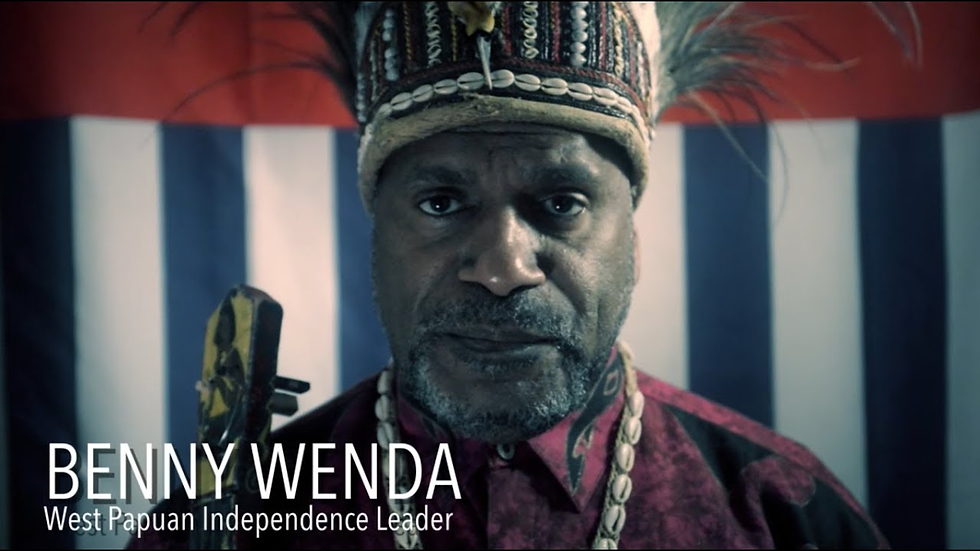
However, the scale of this digital theater is unprecedented. Indonesia now boasts over 212 million internet users, creating a massive domestic echo chamber that is increasingly susceptible to the "borderless" security threat posed by the Papuan diaspora. Operating from the UK, Australia, and Vanuatu, these networks amplify local grievances into global outcries. While the Indonesian government effectively exposes bot accounts and "fake news" targeting European audiences, this state-centric posture creates a strategic blind spot. By prioritizing the image of the state over the safety of the individual, the government inadvertently gifts the diaspora network its most potent ammunition: the narrative of a "repressive occupier" that values land more than lives.
The Labeling Dilemma: KKB as "Terrorists"
The April 2021 designation of the Armed Criminal Group (KKB) as “terrorists” was a pivotal moment in this narrative war. Legally, the move was grounded in Law No. 5 of 2018, as KKB attacks on teachers, health workers, and public infrastructure like the Grasberg shooting clearly meet global criteria for terrorism.
In digital spaces, this labeling serves a strategic purpose: it reframes the conflict from a political struggle to a criminal-justice issue, justifying “extraordinary measures.” However, this creates a securitization dilemma. When an employee like Simson Mulia is killed, the digital response often devolves into a game of finger-pointing. To the international community and the "silent majority" in Papua, a purely repressive approach looks less like counter-terrorism and more like a failure of governance. When the state remains the sole referent object, the "terrorist" label is often viewed through a lens of skepticism, rather than a shared recognition of a common threat.
To understand why the state-centric approach has hit a ceiling, one must look at the "sobering" gap between financial capital and human outcomes. In 2024, the Indonesian government allocated approximately Rp 12.4 trillion (approx. $ 740 million) in Special Autonomy (Otsus) funds and infrastructure for Papua. This represents a massive investment in the "state" as a provider of physical infrastructure and administrative presence.
Yet, the human reality remains stark. Despite these millions, the poverty rate in Papua remains the highest in Indonesia at roughly 26-27%, a jarring contrast to the national average of 9%. This fiscal disconnect provides the "oxygen" for the Netwar. The diaspora network does not need to manufacture fake news when they can simply point to official poverty statistics and the lack of basic health services in the highlands.
Moreover, the human cost of the tactical stalemate is rising. According to data from ACLED and local monitors, displacement due to KKB-TNI clashes has affected between 60,000 to 100,000 civilians since 2018. This "Human Security gap" is the space where cognitive wars are won or lost. Every displaced family is a potential recruit for the separatist narrative; every failed school is a digital weapon used by the ULMWP to argue that Indonesia’s presence is purely extractive.
The True Referent Object: Human Security
When digital discourse is reduced to a binary of pro-independence propaganda versus rigid state-centric updates, the primary victims are the aspirations of the "silent majority" who desire peace and dignity. To break this destructive cycle, the TNI’s operational logic must undergo a fundamental paradigm shift toward a Human Security model.
By repositioning the individual Papuan as the referent object, the military’s role evolves from mere territorial defense to the active cultivation of "freedom from fear." This means prioritizing the physical protection of civilians—like those working the transit routes of Tembagapura—against violence regardless of its source. When the TNI focuses on protecting the Papuan grandmother going to market or the student in Jayapura, it effectively strips the KKB of their claim to be the sole "protectors" of the people.
Furthermore, this security cannot exist in a vacuum; it must be reinforced by "freedom from want." When the TNI supports a security environment where development is not just a top-down infrastructure project but an inclusive, culturally sensitive process, it effectively disarms the digital grievances used by the diaspora network. In this light, human dignity becomes the ultimate counter-insurgency tool.
To win a Netwar, you don't need a louder megaphone; you need a better message. Indonesia must move beyond defensive counter-propaganda and embrace humanistic mediation. The government should utilize digital spaces to facilitate transparent, two-way communication that listens to the voices of customary leaders (Ondoafi), religious figures, and the youth.
Digital narratives should be leveraged to build Confidence Building Measures (CBM) on a national scale. This involves acknowledging historical wounds and demonstrating a commitment to the enforcement of human rights in real-time. If the TNI’s digital presence shifted from "denying violations" to "documenting the protection of Papuans," the international narrative would shift overnight.
Conclusion: The Win-Win Solution
The question of the referent object is not an academic exercise; it is a strategic necessity. If the state remains the only thing we protect, we will continue to see a cycle of radicalization and repression that traditional military boots cannot stomp out. However, if we reposition the indigenous Papuan person as the primary referent object, our narratives will naturally evolve from defensive counter-propaganda into a proactive search for a win-win solution.
People and policymakers alike must recognize that the most effective counter-narrative to separatism is not a more sophisticated bot-net, but a demonstrable commitment to the dignity and welfare of every citizen in Papua. Only when the "silent majority" feels that the state is their shield—rather than just a border guard—will the digital space become a bridge for reconciliation rather than a theater of war.
Disclaimer Please refer to our website and social media links (ISI bio) for comprehensive details. Supplemental references are attached. Please be advised that all processes are conducted in accordance with our AI Usage Policy.


DH88 hôm trước mình cũng tiện tay ghé thử vì thấy mọi người nhắc hoài. Mình không có ý định ngồi nghiên cứu sâu hay chơi gì, chỉ muốn xem trang họ làm có dễ nhìn không thôi. Lướt vài phút thấy bố cục khá sạch, kiểu chia nội dung thành từng mảng nên kéo xuống không bị rối mắt. Có một đoạn giới thiệu họ để thông tin giấy phép PAGCOR với chứng chỉ GEOTRUST ngay trong phần nội dung, đọc lướt qua cũng thấy đỡ “mù mờ” hơn so với mấy trang hay giấu. Mình cũng thích kiểu chữ và khoảng cách dòng, nhìn đỡ mỏi, nhất là khi xem trên điện thoại. Nói chung cảm giác điều…
tylekeo.design hôm bữa mình thấy lướt qua trên feed nên tiện bấm vào xem cho biết. Mình cũng không phải kiểu ngồi nghiên cứu sâu, chỉ xem giao diện với cách họ trình bày thôi. Thấy ổn ở chỗ mấy phần “tỷ lệ kèo” với “kèo bóng đá là gì” được đặt ngay đầu, tiêu đề to rõ nên người mới đọc không bị rối. Nội dung chia đoạn ngắn, đọc lướt vẫn hiểu kiểu tỷ lệ kèo là con số thể hiện khả năng xảy ra của một tình huống trong trận, chứ không vòng vo. Mình thích nhất là bấm qua lại giữa các bài khá mượt, không bị lạc vì menu để dễ nhìn và các khối…
This article thoughtfully explains how human security perspectives help us understand the Papua narrative beyond digital conflict discussions. When I worked on a political analysis assignment covering regional security issues, I found it difficult to present balanced arguments and chose to write my assignment with academic guidance. The post reminded me that sensitive topics need careful research and empathy to avoid oversimplified conclusions.