
Strategic Transformation of Archipelagic Defense: The Multidimensional Role of the Aircraft Carrier Cruiser Giuseppe Garibaldi in the Indonesian National Defense Framework (2025-2029)

By: Dr. Ian Montratama which also has been published first in The Jakarta Post
Introduction: The Archipelagic Strategic Imperative
Indonesia is the world’s largest archipelagic state, controlling approximately 6.4 million km² of maritime territory, including strategic Alur Laut Kepulauan Indonesia (ALKI) and the Exclusive Economic Zone (EEZ). The nation’s defense doctrine, Sishankamrata (Total People’s Defense and Security System), and the updated UU Nomor 3 Tahun 2025 emphasize the need for a layered defense capable of protecting the buffer, main, and resistance zones. The relocation of the national CoG to IKN in East Kalimantan places the capital in immediate proximity to the strategic ALKI II and maritime flashpoints in the North Natuna Sea. Current defense planning, as outlined in the Draf Jakumhanneg 2025-2029, demands a "Mobile Defense" strategy that is adaptive to Revolution Industry 4.0 and 5.0. Within this context, the acquisition of a high-mobility platform like the Giuseppe Garibaldi (CCGG) is a structural necessity to bridge gaps in sensor coverage and rapid response capabilities.
Technical Profile: ASW Aircraft Cruiser vs. LHD

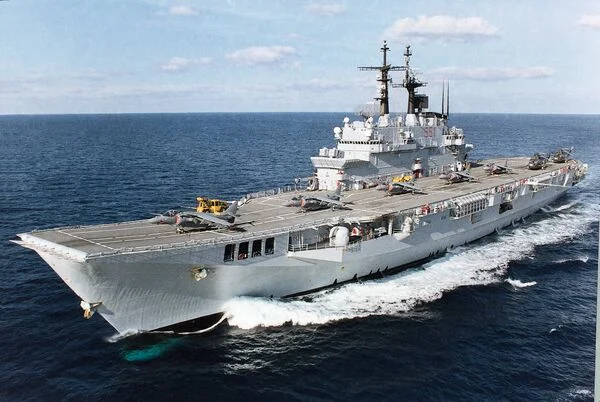
The Giuseppe Garibaldi served as the flagship of the Italian Navy from September 30, 1985, until its planned decommission on October 1, 2024. It is classified as an aircraft-carrying cruiser (CC), a distinction that emphasizes its organic heavy armament and high-speed propulsion compared to transport-oriented amphibious ships. For Indonesia, this platform is envisioned not just as a carrier but as a mobile command hub for the North Natuna Sea and the new Center of Gravity at Ibu Kota Nusantara (IKN). The vessel is designed for rapid transit across vast maritime territories, which is essential for the Indonesian archipelago’s three strategic sea lanes (ALKI). The ship has a displacement of 14,150 tons and an overall length of 180.2 meters. It possesses a beam of 33.4 meters and a draught of 8.2 meters, providing stability for aviation operations in diverse sea states. he cruiser is powered by four GE Avio LM2500 gas turbines, generating a total of **81,000 hp. It maintains a strategic range of 7,000 nautical miles (13,000 km) at a sustained speed of 20 knots, allowing for prolonged “Forward Presence" in Indonesia’s Exclusive Economic Zone (EEZ). The primary strength of the Giuseppe Garibaldi lies in its ability to project power via the Short Take-Off and Vertical Landing (STOVL) flight deck and its extensive hangar. The upper deck can accommodate a maximum of 18 helicopters or a mix of helicopters and STOVL aircraft such as the AV-8B Harrier II. The lower deck is dedicated to the maintenance and housing of the aviation wing, as well as kompartemen for the crew. In the Indonesian context, the deck is capable of hosting TNI AD AH-64E Apache attack helicopters, TNI AL ScanEagle UAVs, and TNI AU EC-725 Caracal heavy-lift helicopters. The ship is also being considered for conversion into a dedicated UAV carrier, with a capacity to operate more than 40 Unmanned Aerial Vehicles.
Unlike most carriers that rely entirely on escorts, theGiuseppe Garibaldi possesses significant organic defensive and offensive weaponry. She is equipped with two Mk.29 octuple launchers for Sea Sparrow or Aspide Surface-to-Air Missiles (SAM). un Systems: She features three Oto Melara Twin 40L70 DARDO cannons for Close-In Weapon System (CIWS) protection. She is also armed with two 324 mm triple torpedo launchers, reinforcing its role as a premier ASW platform. While she has sensors like Selenia SPS-774 (RAN-10S) and Hughes AN/SPS-52C long-range radars, Selenia SPS-702 CORA surface search radar, and three Selenia RTN-30X radars for missiles and three RTN-20X for the CIWS cannons. The ship features a Selenia CMS SADOC-3 and extensive C4 infrastructure, making it suitable for hosting 100 C4 staff to manage large-scale joint operations.
It is technically vital to note that the Giuseppe Garibaldi does not have a well deck or a ramp door. Therefore, she cannot perform "roll-on/roll-off" pergeseran (movement) of heavy armor or amphibious vehicles like a Mistral-class LHD. While an LHD focuses on transporting 450- 900 troops and 40 main battle tanks, the Garibaldi is optimized for fleet speed, air defense, and hunting submarines. Her role as a force multiplier for ASW and a terminal command node for Indonesia Archipelagoc Air Defense Systems (IAADS) makes it an ideal flagship for Indonesia’s "Mobile Defense" strategy in the 2025-2029 period. Its integration into the TNI structure fulfills the constitutional mandate to protect the integrity of the archipelagic territory.
A critical distinction must be made between the Giuseppe Garibaldi (CCGG) and traditional Landing Helicopter Docks (LHD) like the Mistral class. Acquiring the Giuseppe Garibaldi is like Indonesia moving from having a series of small, fixed observation posts to a high-speed mobile command van. While a cargo truck (LHD) is better for moving heavy furniture (tanks), this command van is equipped with the best cameras (radars) and radios (C4 data links), and it carries its own rapid-response motorcycles (jets and helis) to intercept an intruder before they even reach the gate.
The Multidimensional Role of CCGG for TNI
IAADS, or "Cakra," is the blueprint for TNI AU Posture 2025-2044. This system integrates Sensors, Shooters, and Command and Control (C2). Archipelagic geography creates radar "blind spots". The CCGG serves as a mobile sensor platform, deploying Airborne Early Warning (AEW) assets and UAVs like the ScanEagle or CH-4. This extends the national radar horizon to the edge of the EEZ, providing a Common Air Picture for the North Natuna Sea and IKN. In the "Cakra" framework, the CCGG functions as a Terminal Command node. It allows for Decentralized Execution from a Centralized Control center. By carrying STOVL fighters and attack helicopters (e.g., AH-64E Apache), the CCGG provides immediate air interception capabilities that land-based assets may not reach in time due to distance. The Jalesveva Jayamahe doctrine mandates the Navy to maintain Sea Control—the freedom to use the sea for national interests while denying it to the enemy. Originally designed as an ASW cruiser, the CCGG enhances Indonesian Navy capabilities for detecting and neutralizing underwater threats in Indonesia’s strategic choke points (Malacca, Sunda, Lombok, and Makassar straits). Moreover, by maintaining a "Forward Presence" in contested waters like Natuna, the CCGG fulfills the Deterrence (Penangkalan) function, signaling Indonesia’s.
resolve to defend its sovereignty. The ship also provides a base for maritime patrol aircraft and rapid-response teams to combat piracy, illegal fishing, and smuggling. While Indonesian armed forces maintains the PPRC (Quick Reaction Strike Force) that requires the seamless integration of all military matras. The CCGG can transport Army’s Kostrad units and AH-64E Apache for air-mobile strikes in remote islands. She can also act as a sea-based hub for Air Force heavy-lift helicopters (EC-725 Caracal) and medium UAVs, ensuring air operations continuity when land airfields are targeted. While at her Navy, the CCGG serves as the flagship of a task force that includes Landing Platform Docks (LPD) and Landing Ship Tanks (LST). While the LPDs carry heavy armor, the CCGG provides the air cover and ASW shield necessary for the force's survival. Under the Tri Dharma Eka Karma doctrine, TNI may enhance its participation in global peace missions. The ship can serve as a mobile command center or hospital for UN missions and large-scale disaster relief (Civic Missions) for Garuda Contigents. While participations in highprofile exercises like RIMPAC or Super Garuda Shield with a carrier-centric fleet elevates Indonesia to a "World Class Navy".
Closure The acquisition of the CCGG involves significant challenges that must be addressed in the 2025-2029 budget cycle. Operational costs for a 14,000-ton turbine ship are high. Strategy must focus on an "Interim Use" approach, prioritizing the 7,000 nmi range for high-priority flashpoints. While there is an urgent need to establish the Air Warfare Training Centre (AWTC) to train personnel in advanced Air Battle Management and Signal Analysis. Integration of diverse weapon systems also requires a "Triple Helix" collaboration between the TNI, defense industry, and academia. Nevertheless, the integration of the ex-Italian Navy Giuseppe Garibaldi represents a strategic leap for Indonesia’s national defense. By serving as a mobile "Wi-Fi router" and "fire station" for the ocean, the CCGG provides the digital network (data link) that connects scattered archipelagic units and the physical response force (helicopters and drones) to reach emergencies faster than land-based assets. To become prosperous nation in 2045 requires strong military power to uphold the domestic and regional security stability
References
Doktrin TNI AD Kartika Eka Paksi (2020).
Doktrin TNI AL Jalesveva Jayamahe (2018).
Doktrin TNI AU Swa Bhuwana Paksa (2019).
Doktrin TNI Tri Dharma Eka Karma (2018).
Draf Kebijakan Umum Pertahanan Negara (Jakumhanneg) 2025-2029.
FGD ISI-UNHAN Report: Aircraft Carrier Cruiser Giuseppe Garibaldi (2025).
Sishanudnas Cakra/IAADS Concept Document (2023).
Mahan, A.T. (1890). The Influence of Sea Power upon History, 1660-1783. (Essential for understanding the geopolitical weight of naval capital ships).
Till, G. (2013). Seapower: A Guide for the Twenty-First Century. (Contextualizes modern naval roles including carriers).
Indonesian Ministry of Defense. Defense White Paper. (Current official stance on maritime security).
Jane’s Fighting Ships. (For detailed technical comparisons of the Garibaldi with other regional platforms like Thailand's Chakri Naruebet).
Marsetio (2024). Sea Power Indonesia di Era Indo Pasifik. Jakarta: UNHAN RI Press.
Suropati, Montratama, Sulaiman (2019). Indonesia Inc.: Peta Jalan Menuju Poros Maritim Dunia. Jakarta: Elex Media Komputindo.
https://web.archive.org/web/20120102030203/http://www.netmarine.net/bat/tcd/mistr al/index.htm
https://indonesiadefense.com/kemhan-rencana-akuisisi-kapal-perang-053h-dari-cinamasih-dikaji/
"Giuseppe Garibaldi Portaeromobili". GlobalSecurity. https://www.globalsecurity.org/military/world/europe/garibaldi.htm
https://www.globalsecurity.org/military/world/europe/mistral-program.htm
https://www.globalsecurity.org/wmd/library/news/russia/2011/russia-110617- rianovosti01.htm
Strategi Pertahanan Laut Nusantara (SPLN). 24. Undang-Undang Nomor 3 Tahun 2025


The article talks about how Indonesia is rethinking its defense strategy by using an aircraft carrier as a more flexible and modern tool for protecting its wide island geography, which makes coordination across seas very important. It also highlights how military planning is becoming more multidimensional, focusing on speed, reach, and adaptability. I once felt overwhelmed with studies and thought about Finish my online finance class just to reduce pressure, which made me relate to how people look for stronger systems when challenges feel too complex. In the end, both situations show the need for structure to handle complexity better.