
What Should Indonesia Prepare When the Arctic Route Becomes Viable?

By: Arrozaq Ave
For centuries, global trade has been shaped not only by economics, but also by geography. A relatively small number of maritime chokepoints have played a major role in this system. The Strait of Malacca, Suez Canal, Strait of Hormuz and Bab-el-Mandeb are examples of waterways that are difficult to avoid without adding significant distance and cost to a voyage.
The Arctic is now increasingly being discussed as a new option. As sea ice melts, the Northern Sea Route (NSR) along Russia's Arctic coast is becoming more accessible during part of the year. Russia has invested heavily in the route, while China has also started to see it as a potential component of its wider trade and connectivity strategy.
For Jakarta, however, the important question is not simply whether the Arctic route is becoming viable. The more relevant question is what this development actually means for Indonesia's trade, economic interests and strategic position in Southeast Asia.

A short history of the chokepoint economy
The Suez Canal opened in 1869 and changed the geography of global trade. It provided a much shorter connection between Europe and Asia than sailing around the Cape of Good Hope. The Panama Canal created a similar advantage for trade between the Atlantic and Pacific oceans.
The importance of these canals does not come only from their existence. They became commercially important because they offered enough savings in distance, sailing time and fuel to make the tolls and other costs acceptable to shipping companies. At the same time, ports, insurance arrangements, shipping schedules and other supporting services developed around them.
There have been several proposals to create alternatives to existing routes. The Kra Canal in Thailand, for example, has been discussed for many years as a possible alternative to the Strait of Malacca. Yet these projects have not changed the existing maritime system. A new route has to be not only shorter. It also needs to be safe, reliable, commercially competitive and supported by adequate infrastructure.
The NSR is not a canal and is not a year-round replacement for the Suez Canal. It is a seasonal maritime corridor whose commercial viability depends on ice conditions, ice-class vessels, navigation services, insurance and supporting infrastructure. The route is therefore becoming more commercially relevant, but it is still far from becoming a normal alternative for the global shipping industry. Recent research also suggests that the route's actual cargo volumes remain well below some of the targets previously announced by the Russian government.
The current race: Russia, China, and a wary United States
The commercial argument for the NSR is quite straightforward. For some China-Europe voyages, it can significantly reduce sailing distance and transit time compared with the traditional route through the Suez Canal.
This advantage is now being tested in practice. In 2025, Sea Legend Line conducted a trial container voyage between China and Europe through the Arctic. In 2026, the company moved further by scheduling eight consecutive weekly sailings from Ningbo-Zhoushan to Felixstowe during the Arctic navigation season. The service is designed for selected cargoes where shorter transit time can justify the additional risks and costs associated with Arctic navigation.
Russia, meanwhile, has a much broader interest in the route. The NSR is not only a potential international trade corridor for Moscow. It is also important for moving oil, LNG and other resources from the Russian Arctic to Asian markets.
This has become particularly visible in 2026. Reuters reported that seven tankers had already transported around six million barrels of Russian crude through the NSR towards Asia by August. This was already close to half of the total volume transported through the route during the whole of 2025. The route can reduce the voyage time to Asian destinations such as China by around two weeks compared with more traditional routes.
China's interest is therefore understandable. The Arctic route can provide an additional option for China-Europe trade and, more importantly from a strategic perspective, another route for some energy supplies from Russia.
This does not mean that China can simply replace the Malacca Strait with the Arctic. The two routes serve different purposes. The Arctic route is mainly relevant to the Europe-Asia corridor and to Russian energy exports. The Strait of Malacca remains much more important for China's wider energy imports from the Middle East and other suppliers.
The geopolitical dimension should also not be ignored. Russia has a large icebreaker fleet and has invested heavily in Arctic infrastructure. At the same time, the United States and its allies have become increasingly concerned about the strategic importance of the region. Russia's Arctic capabilities remain substantially larger than those of the United States, particularly in terms of icebreakers .
Still, there are important limitations. The Arctic route remains seasonal. The 2026 Sea Legend service, for example, is concentrated between August and October. The route also requires specialised vessels, additional navigation arrangements and higher insurance costs. Infrastructure, search-and-rescue capability and other supporting services are much less developed than along established global shipping routes.
Therefore, the Arctic should currently be viewed as an additional route rather than a replacement for Suez.
Where Indonesia actually sits in this picture
This is where the discussion becomes more interesting for Indonesia. It is tempting to assume that if the Arctic route reduces traffic through the Strait of Malacca, Indonesia will automatically be negatively affected. I do not think this conclusion is correct.
The first issue is to understand what the Malacca Strait actually does for global trade and what Indonesia gains from it. The Strait of Malacca is one of the world's most important maritime chokepoints. A very large volume of energy and commercial shipping passes through the strait every year. Its importance is significant for East Asian economies because it provides a relatively efficient connection between the Indian Ocean and the Pacific. Historical shipping data already showed more than 100,000 oil and cargo vessels using the strait annually in the 1990s, illustrating how long-standing its role has been .
For China, the strategic importance is even greater. A significant share of its imported energy has traditionally moved through the Malacca Strait . This has contributed to what is commonly described as China's "Malacca dilemma": the concern that a major disruption in the strait could affect China's energy security. The Arctic route provides China with some additional flexibility, but only for certain trade flows.
Now compare this with Indonesia's own trade structure. Indonesia's largest export market is China . BPS data for January-November 2025 show that China accounted for 23.8 percent of Indonesia's non-oil and gas exports, followed by the United States at 11.5 percent and India at 6.72 percent. These three markets together accounted for more than 42 percent of Indonesia's non-oil and gas exports.
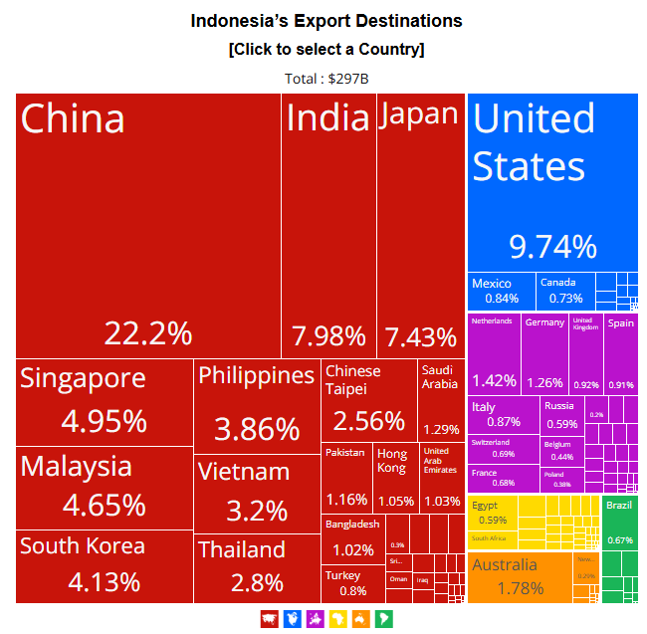
The composition of trade is also important. Indonesia's exports to China are strongly connected with iron and steel, mineral fuels and nickel products. At the same time, China is also the largest source of Indonesian imports . In 2025, China accounted for 36.22 percent of Indonesia's total imports, with machinery, electrical equipment and other manufactured goods among the major import categories.
This gives us a different picture from the usual discussion of the Arctic. A significant part of Indonesia's trade is regional and Asia-facing. Indonesian commodities such as coal, nickel products, iron and steel and palm oil are mainly sold to markets in Asia. Indonesia is therefore not heavily dependent on the China-Europe shipping corridor that the Arctic route is primarily trying to serve.
A tonne of Indonesian nickel product shipped to China does not become cheaper or more expensive simply because a Chinese container ship can reach Rotterdam more quickly through the Arctic. This is an important distinction.
What this means for Indonesian trade and the economy
If the Arctic route becomes commercially successful, the direct impact on Indonesia's current export performance is likely to be limited. The main beneficiaries of the route will initially be countries and companies involved in the East Asia-Europe corridor. Chinese, Japanese and South Korean manufacturers, for example, could use the route for selected cargoes heading towards European markets. Russian energy exports to Asia are another major source of traffic.
Indonesia is in a different position. Indonesia exports mainly to Asian markets that are already relatively close to the country. China, India, Japan and South Korea are important destinations for Indonesian commodities. While Europe remains an important market, it is not the primary destination for the country's exports. Taking note, when viewed as a single bloc, the European Union ranks as Indonesia's fourth-largest export destination
This means that the Arctic route does not create an immediate alternative route for most Indonesian exports. There is another important point.
Indonesia does not collect a direct transit toll from ships passing through the Strait of Malacca. The strait is an international waterway, and its management involves Indonesia, Malaysia and Singapore in different areas of safety, security and navigation.
Therefore, if some international shipping moves from Malacca to the Arctic, Jakarta would not suddenly lose canal-type revenue in the way Egypt could be affected if Suez traffic declined. The benefit Indonesia receives from the Malacca Strait is more indirect. It comes from geography, strategic relevance, maritime security responsibilities, shipping services and its position within the wider regional logistics system.
This does not mean these benefits are insignificant. But they are different from collecting a direct toll. For this reason, the impact of the Arctic route on Indonesia is more likely to be gradual and strategic rather than an immediate shock to trade statistics.
Thus, in this discussion of the Arctic Route and what Indonesia should monitor, there are at least three areas things need to be considered:
First, the strategic importance of the Malacca Strait could gradually change. If China develops a meaningful alternative route for part of its energy and trade flows, its dependence on the Malacca Strait would be somewhat reduced. This does not make Malacca unimportant. The scale of trade through the strait is simply too large for that. However, the strategic value of the strait could change at the margin.
Second, the Arctic could influence global shipping and port investment over the longer term. If the route eventually handles much larger volumes, shipping companies may begin to reconsider the location of some logistics facilities and the structure of Asia-Europe services. Russia has previously set ambitious targets for NSR cargo volumes, including an earlier target of 80 million tonnes and longer-term targets in the range of 220–270 million tonnes by 2035 . However, these should be treated as policy ambitions rather than forecasts. More recent reporting indicates that Russia has revised some of these targets downward. It is too early to assume that the Arctic will reach these volumes.
Third, Indonesia should consider the geopolitical implications. A more Arctic-capable China would have more options in dealing with maritime disruptions. This could marginally reduce the strategic importance of Southeast Asian chokepoints in China's calculations.
However, this should not be overstated. Indonesia's relationship with China is not based only on the Malacca Strait. Trade in nickel, iron and steel, coal, palm oil and manufactured products provides a much broader economic relationship. Even if the Arctic becomes more important, China will continue to have strong reasons to maintain stable relations with Southeast Asia. In other words, the Arctic route may reduce one element of China's dependence on the region, but it does not remove the economic importance of the region itself.
Conclusion
The basic intuition behind this analysis is therefore quite simple: Indonesia is relatively insulated from the immediate economic impact of an emerging Arctic shipping route because much of Indonesia's trade is Asia-facing and commodity-based. The Arctic route is mainly relevant to the East Asia-Europe corridor and to Russian energy exports. It does not directly compete with most of Indonesia's current export routes.
This does not mean Indonesia should ignore the development. The more important lesson is about the limits of geography as a long-term economic advantage. Indonesia sits next to one of the world's most important maritime chokepoints, Strait Malacca, along its ALKIs, but proximity to a chokepoint does not automatically create economic value. Singapore has been much more successful in capturing the logistics, financial and service activities surrounding regional shipping. Indonesia's opportunity is therefore not simply to hope that ships continue to pass nearby. Instead, Indonesia should focus on what economic value it can capture from its geographic position: ports, logistics, maritime services, ship-related industries, energy infrastructure, digital trade services and regional supply chains.
The Arctic route may eventually become an important part of the global shipping system. But for Indonesia, the immediate issue is not whether fewer ships will pass through Malacca. The more strategic question is whether Indonesia can build an economy that remains competitive even when geography becomes less predictable. For a country that has traditionally benefited from its position between the Indian and Pacific oceans, this is an increasingly relevant policy question.
References
[1] Peter. (2026, March 25). Russia’s Arctic cargo route loses ground as volumes fall and China fills the gap left by the West. Breakbulk
[2] Yang, C. (2026, July 24). How can Sea Legend reach Europe in 20 days? Inside the operational system behind the CAX Arctic Express. Xinde Maritime News.
[3] Reuters. (2026, August 11). Russia's oil exports to Asia via Arctic route start strongly, sources say and data shows.
[4] Reuters. (2026, June 26). NATO allies promised Trump they'd secure the Arctic; they've got work to do. Reuters. https://www.reuters.com/business/aerospace-defense/nato-allies-promised-trump-theyd-secure-arctic-theyve-got-work-do-2026-06-26/
[5] Sari, M. N., Rudiyanto, R., Legowo, E., Widodo, P., Saragih, H. J. R., & Suwarno, P. (2023). Indonesian geostrategy on international maritime transportation in the Malacca Strait. International Journal of Progressive Sciences and Technologies, 37(2), 372–381.
[6] Chua, T.-E., Gorre, I. R. L., Ross, S. A., Bernad, S. R., Gervacio, B., & Ebarvia, M. C. (2000). The Malacca Straits. Marine Pollution Bulletin, 41(1–6), 160–178. https://doi.org/10.1016/S0025-326X(00)00108-9
[7] Badan Pusat Statistik. (2026, March 3). BPS: Manufacturing products support the continued growth of non-oil and gas exports.
[9] TradeInt. (2026, March 9). Indonesia import data 2025: Suppliers, categories & trends. https://tradeint.com/insights/indonesia-import-data/
[10] PortNews. (2023, March 2). NSR cargo traffic may reach 90 million tonnes by 2024 and 216 million tonnes by 2030. https://en.portnews.ru/news/343747/
Disclaimer
Please refer to our website and social media links (ISI bio) for comprehensive details. Supplemental references are attached. Please be advised that all processes are conducted in accordance with our AI Usage Policy.
About Authors
Arrozaq is passionate about working in the fields of economics, energy, and sustainability. Arrozaq has been working as a government official as Senior Policy Analyst at the Coordinating Ministry for Economic Affairs - Republic of Indonesia for 5 years. Specifically on sustainability, energy and climate change sectors. With his commitment to sustainability and the economy, Arrozaq has been certified as SDG Leader by UNDP, Australian Award and has become one of the best government officers in ministry. Arrozaq is also active on a number of international forums like G20, OECD, OIC, ASEAN and others.
In the meantime, Arrozaq is assigned as executive secretary in Indonesia JCM Secretariat, which promotes low carbon development in Indonesia. This bilateral cooperation between Japan and Indonesia with the concept of carbon offsetting, is equipped with methodology, consultations, verification and validation according to ISO 14045. There are 56 Decarbonizations projects under Arrozaq supervision of which 12 of them have issued carbon credits. Arrozaq graduated from ITB (Bachelor of Engineering), and got Master's from Mercu Buana University (Management) and Trisakti University (Economy). Arrozaq also plays roles as associates at Think Policy (Public Policy Think Tank).


Comments