
Navigating The New Realism: The Trumpian Paradigm and Indonesia’s Strategic Autonomy

By: Dr. Ian Montratama, S.E., M.E.B., M.Si. (Han)
Dr. Ian is the Director of Research and Development at ISI (2025) and a Lecturer in International Relations at Universitas Pertamina. He holds a Doctor of International Relations (cum laude), a Master in European Business from EDHEC Lille, and a Master in Total War Strategy from Indonesia Defense University. He is the author of Arungi Samudra RI Bersama Sang Naga, Langit Indonesia Milik Siapa, and Introduction to Indonesian Foreign Policy. He completed an executive program at the Naval Postgraduate School, was a panelist at the 3rd Presidential Debate 2024, and received Best Thesis and Academic Record at PPSA XXIV Lemhannas.
As the global order enters a period of profound systemic disequilibrium, defined by a significant disjuncture between existing international governance and a rapid redistribution of power, Indonesia finds itself at a strategic crossroads. The re-emergence of an "America First" doctrine, articulated in the proposed 2025 National Security Strategy (NSS), represents what the administration views as a "necessary correction" to decades of globalist policies that reportedly hollowed out the American industrial base while allowing partners to offload the costs of their own defense. For Jakarta, this shift toward a "muscular" but "restrained" focus on core national interests necessitates a sophisticated recalibration of its traditional bebas-aktif (independent and active) foreign policy.

The Primacy of Nations and "Flexible Realism"
At the core of the Trumpian paradigm is the principle of the "Primacy of Nations," which asserts that the world functions most effectively when sovereign states prioritize their own interests and guard their autonomy. This "flexible realism" suggests that the United States will no longer seek to impose democratic or social changes on nations with different traditions, provided those nations do not directly threaten American interests.
For a state-centric realist, this implies that international relations are governed by the law of uneven growth, where the differential development of power among states leads to the eventual transformation of the international system. Indonesia, as a pivotal state in Southeast Asia, must recognize that this paradigm shifts the burden of regional security back to local actors, organizing a "burden-sharing network" where partners must assume primary responsibility for their own neighborhoods.
Geopolitical Chokepoints and the South China Sea
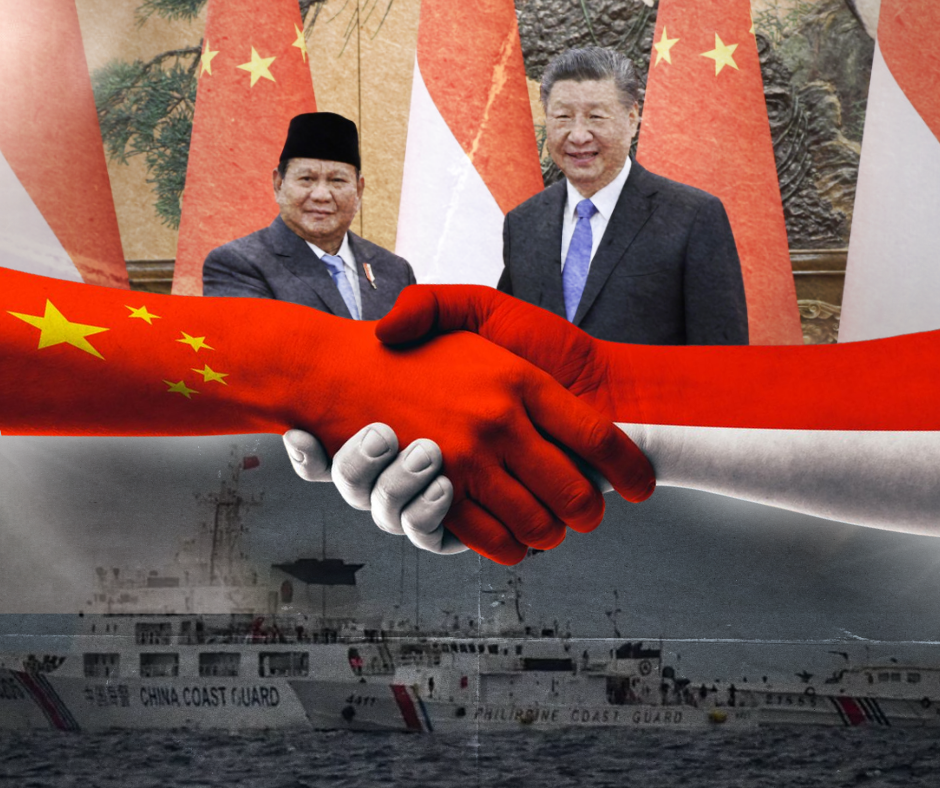
Indonesia’s strategic significance in this era is dictated by a geopolitical reality defined by its control over vital lines of communication and its proximity to centers of resources. The 2025 NSS explicitly identifies the prevention of any hostile power from dominating the South China Sea as a core vital interest, warning of the potential for a competitor to impose a "toll system" or arbitrary closure of these essential commerce lanes. The Straits of Malacca, through which 80 percent of China’s oil imports pass, remain the "maritime chokepoint" of the Indo-Pacific.
From the perspective of state-centric realism, the U.S. intends to maintain "Peace Through Strength" by preserving a military overmatch to deter conflict, particularly over Taiwan, which provides direct access to the "Second Island Chain" running through the Indonesian archipelago. Jakarta must navigate this carefully, as the U.S. will prioritize keeping these lanes "free of tolls" and open for navigation—a stance that may lead to increased military friction as China builds a "blue-water navy" capable of challenging American maritime hegemony.
The "China Price" and Economic Sovereignty
A central pillar of the Trump administration’s security policy is the recognition that economic security is national security. The sources emphasize that China has emerged as a conventional threat to the American "liberal imperium" by utilizing "weapons of mass production"—driven by currency manipulation, massive subsidies, and intellectual property theft—to conquer
export markets. The 2025 NSS prioritizes "Balanced Trade" and seeks to end "dumping and other anti-competitive practices" that disadvantage American workers.
For Indonesia, this creates an opportunity to position itself as a preferred "near-shore" or "friendly-shore" partner as the U.S. seeks to "re-shore" supply chains and reduce reliance on adversaries. However, this comes with the expectation that Jakarta aligns its export controls with American standards and resists measures such as targeted taxation or expropriation that disadvantage U.S. businesses. Jakarta must understand that in this new era, trade relations are increasingly viewed as a zero-sum game where reciprocal access is the mandate.
Matching Geostrategy to Reality
The Trumpian international security policy offers a world of "sovereign countries and free economies," but it is a world that demands a high price for strategic independence. Indonesia can no longer afford to be a "free-rider" on American-provided maritime security; instead, it must match its own geostrategy—the geographic direction of its foreign policy—to the underlying geopolitical reality.
By securing its own borders and participating in a targeted "burden-sharing network," Indonesia can preserve its autonomy. Failing to adapt to this shift toward the Pacific as the "main theater of action" may result in being caught in the maelstrom of a hegemonic struggle it cannot control. Ultimately, the success of the Indonesian geopolitical vision—Wawasan Nusantara—depends on an unerring eye for trade routes and strategic interests, ensuring that its foreign policy is adjusted to the specific position it occupies in the changing world.


Comments